A child’s backyard is supposed to be a place of laughter, play, and safety—a space where imaginations run free and worries don’t exist. But for 10-year-old Braxton Bragg, that space became the site of every parent’s worst nightmare.
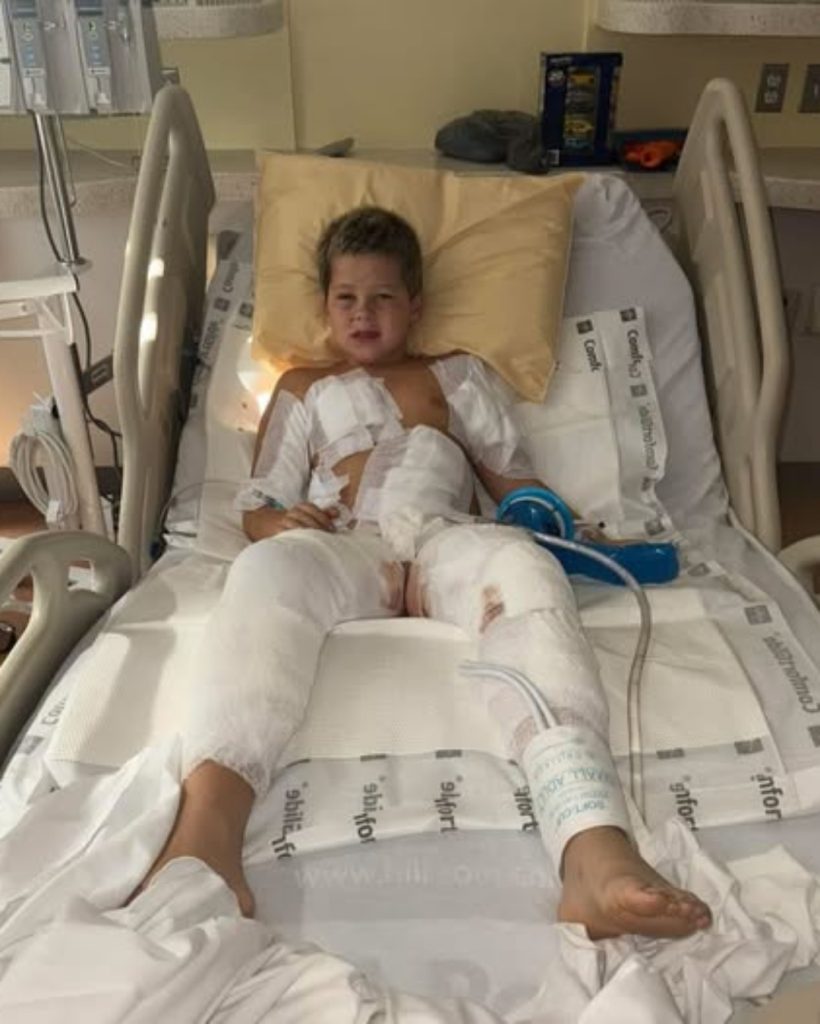
One ordinary day turned tragic when Braxton was brutally attacked by three large dogs that entered his family’s yard unprovoked. There was no warning, no chance to escape—just sudden chaos and terror as the dogs launched their violent assault.
The attack left Braxton with devastating injuries. His little body was covered in deep wounds, his life hanging by a thread. Emergency responders rushed him to a local hospital, but it quickly became clear that the severity of his injuries demanded more. He was life-flighted to Texas Children’s Hospital in Houston, where doctors began the desperate fight to save him.

Since that day, Braxton has already endured five major surgeries. Surgeons worked tirelessly, closing torn flesh, repairing muscle, and stitching together what the attack had ripped apart. In total, Braxton has received more than 500 stitches, each one a testament to his will to survive. And yet, as miraculous as it is that he lived through the ordeal, his journey is far from over.
The physical wounds are only part of the story. Each day, Braxton battles unimaginable pain as his body struggles to heal. The trauma of the attack still lingers, both in his mind and in the worried hearts of his family. For a child so young, this is a weight no one should ever have to carry. Yet even through the pain, Braxton’s spirit has shown remarkable resilience.
His parents remain at his bedside, holding his hand through each surgery, whispering encouragement, and praying for their son’s strength. They have watched him face procedures that would overwhelm even adults, and still, they see glimpses of their sweet boy’s courage shining through. Every smile, every small victory in his recovery, feels like a miracle.
But the road ahead is long. Beyond the surgeries and medical treatments lies the challenge of emotional recovery. The terror of being attacked in a place he once felt safe will not fade overnight. His family is determined to surround him with love, to remind him that he is safe, and to help him reclaim the joy of childhood that was so violently stolen.
In times like these, a family cannot walk the journey alone. They need the strength of community—the prayers, encouragement, and compassion of people willing to stand with them. Braxton’s parents have asked for just that: prayers for healing, messages of support, and love poured out over their little boy as he continues his fight.
Because Braxton is more than a victim of a senseless attack. He is a fighter, a survivor, a child with dreams still waiting to be fulfilled. His story is heartbreaking, but it is also a reminder of the resilience of the human spirit and the power of love to carry us through the darkest of days.
So tonight, as you think of your own children playing in the yard or drifting off to sleep, remember Braxton. Lift his name in prayer. Send him a message of hope and healing. Let him know that he is not alone—that there are people near and far standing with him, believing in his recovery.
Sweet Braxton is still fighting through unimaginable pain and trauma. He needs all the love, prayers, and support we can give. Send him a get-well message today and remind him he is surrounded by kindness and care.
A Moment of Trust in the Wildfire.1050
The wildfire had been declared too dangerous, and crews were ordered to pull back immediately. Flames tore relentlessly through the trees, consuming everything in their path, and thick smoke hung heavy in the air, swallowing sound and sense alike. The roar of the fire seemed alive, a living force that devoured the forest with an insatiable hunger. Every firefighter on the line felt it—the heat, the smoke, the danger—but orders were clear: retreat and preserve human life above all else.
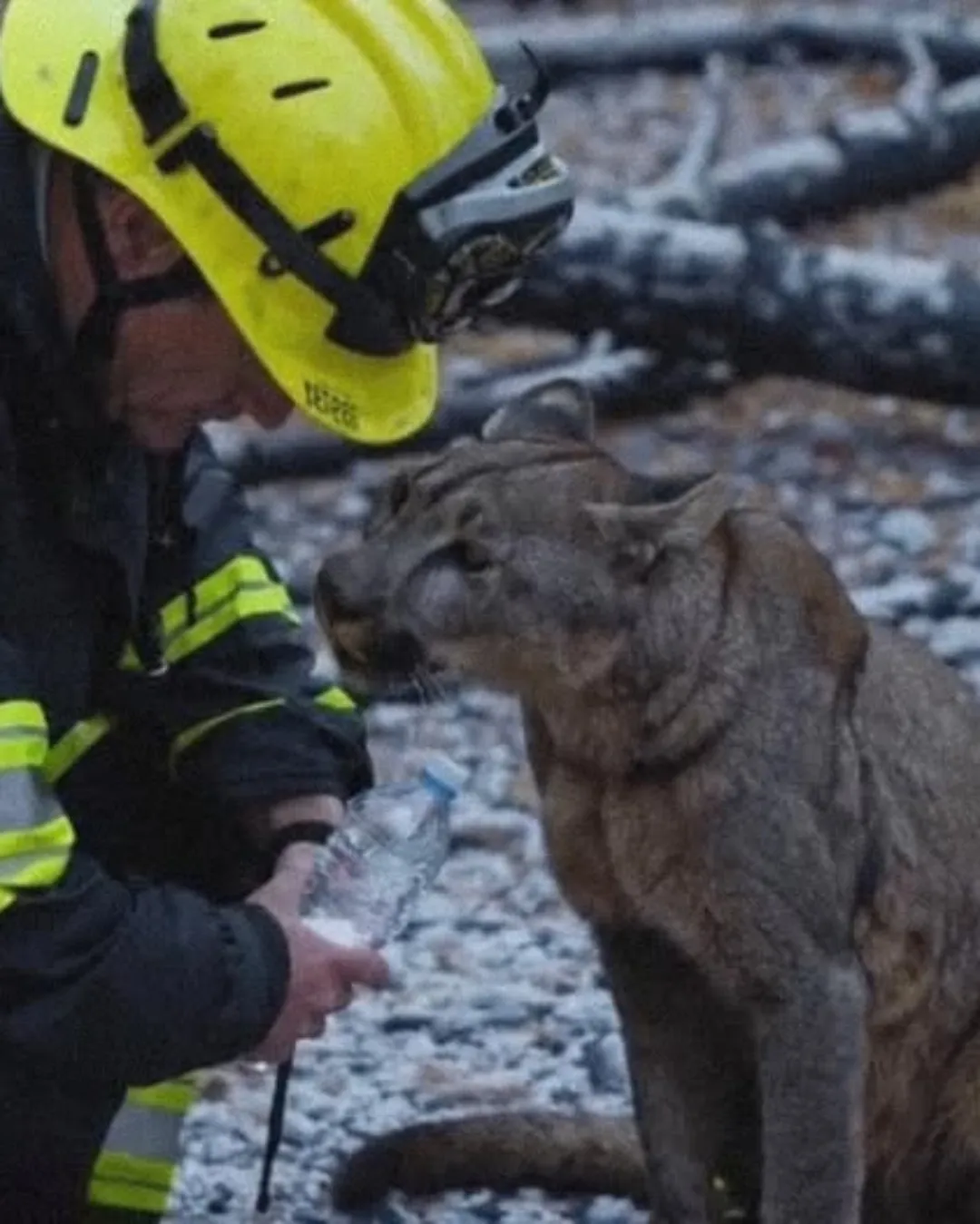
As the team moved back, eyes squinting through the haze, something unusual caught the attention of one firefighter. Through the swirling smoke, a silhouette emerged—a mountain lion. She was not running, not fleeing the chaos, not even growling. She limped painfully, her fur coated in ash, her movements slow and deliberate, and her eyes locked unwaveringly on the firefighter’s water bottle.
He froze, the bottle still in his hand. Around him, his comrades instinctively stepped back, a silent acknowledgment of the danger that came with approaching a wild animal, especially one so close to a fire. But the mountain lion did not growl, did not hiss, and did not retreat. She was exhausted, and she was thirsty. The forest’s usual predator instincts seemed muted by the overwhelming presence of destruction.
For a moment, time slowed. The firefighter could feel the heat of the flames behind him, hear the distant crack of burning branches, smell the sharp tang of smoke in his lungs—but all that faded into the background as he and the lion regarded each other. Slowly, almost reverently, he unscrewed the lid of his water bottle and held it out.

She stepped forward with cautious grace, limping closer, her nose twitching. He could see the ash clinging to her fur, the exhaustion in her movements, the quiet resignation in her gaze. And then, finally, she drank. Slowly, carefully, she lapped at the water, never taking her eyes off him. It was a moment so fragile and so profound that the chaos of the wildfire seemed to disappear. For a heartbeat, there was nothing but trust, vulnerability, and the simple act of kindness bridging the divide between human and wild.
Afterward, when the fire had driven him back and the others were safely out of reach of the inferno, he found a quiet moment alone. Sitting on a fallen log, sweat mingling with ash on his face, he reflected on what had just happened. He knew he had disobeyed orders—he had lingered in a zone deemed too dangerous, risking not only his own life but potentially the lives of those who might have needed to rescue him.
And yet, there was no regret. In that fleeting encounter, the mountain lion had trusted him, relied on him, and he had responded. For a few seconds in the midst of devastation, he had been a guardian, not just of human life, but of a life from the wild that had no other chance in that moment. There was a strange peace in that. A quiet affirmation from nature itself, as if the world had whispered through the smoke and ash: “You did good.”
Even as the fire raged on, consuming the forest and reshaping the landscape, he carried that memory with him. It was not a story of heroics, or medals, or recognition. It was a story of trust, humility, and the fragile connection between species in a world too often defined by destruction. He realized that in the heart of disaster, the smallest gestures—sharing water with a wild animal, slowing down to act with compassion—could leave a mark more lasting than any blaze of flame.
In the days that followed, whenever he closed his eyes, he could see her face: the ash-dusted fur, the weary eyes, the tentative steps toward him. And each time, he felt that quiet, profound sense of peace, that reassurance that, even amid chaos, humanity could still reach out and do something undeniably right.