Aria: A Little Girl Who Shone Too Brightly
At four years old, Aria was a whirlwind of energy and curiosity, a tiny girl whose enthusiasm for life seemed boundless.
She wanted to experience everything the world had to offer, whether it was hiking up the local hill with her dad, scootering seven kilometers around the Bay Run, or dancing to her favorite tunes with unmatched passion.
Her mother, Chrissy, recalls one innocent yet profound moment when she asked Aria what she wanted to be when she grew up. Aria didn’t say a doctor, a teacher, or an astronaut—she said,“I want to be the sun so I can shine on everyone.” That was Aria: bright, warm, and utterly uncontainable.
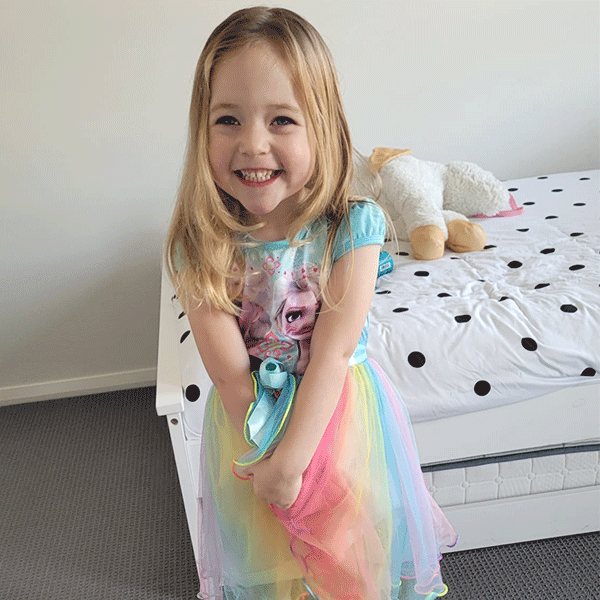
Aria adored dancing, loved cheese, and had a quick wit that made everyone laugh. She doted on her little brother, Lucas, teaching him with patience beyond her years. Life was full of small adventures and big dreams. But in September 2022, that vibrant world came to a sudden halt.
The first warning came unexpectedly. Aria’s preschool called Chrissy to say that her daughter’s glands were swollen. That morning, she had seemed perfectly fine, bouncing around as usual, unaware of the shadow looming over her tiny body.

Chrissy acted on instinct and took Aria to the GP. Glandular fever was suspected, and blood tests were arranged. Even at this early stage, a chilling thought had crossed Chrissy’s mind: what if it’s cancer?
The next day, Aria’s father, Jamie, took her for the tests. When Chrissy and the doctor reviewed the results together, they were both in shock.
The words stared back at them:“indicative of acute lymphoblastic leukaemia.” Chrissy recalls staring at the page in disbelief. “I’m thinking, it’s not real. We don’t have cancer. Aria cannot possibly have cancer,” she remembers thinking, even as a part of her had feared this outcome.

Within days, Aria was at The Children’s Hospital at Westmead. She underwent a lumbar puncture and had a central line inserted to receive fluids and medications. The whirlwind of medical procedures, terminology, and urgent care was overwhelming.
Chrissy and Jamie held on to hope that Aria had the more treatable B-cell acute lymphoblastic leukaemia (B-ALL), only to learn she had T-cell acute lymphoblastic leukaemia (T-ALL), a more aggressive form. To explain to Aria, Chrissy told her she had “bugs in her blood” that needed to be killed—a child-friendly version of the harsh reality of leukemia.

Treatment began immediately. Chemotherapy sessions, blood tests, and clinic visits became the new normal. Aria, a spirited child, refused nasogastric tubes and hated taking medicines. Yet Chrissy found inventive ways to get her to cooperate.
She would present the medicines like a menu: “Do you want the one that tastes like a donut, or the one that tastes like poo?” Aria would giggle, make a choice, and bravely take it. Despite the challenges, six months into treatment, she was nearing remission—a small victory in a long and grueling journey.
But cancer’s shadow had not lifted. After finishing the intensive phase of chemotherapy in February 2023, Aria’s recovery was stalled. Her blood counts remained low, and unexplained fevers plagued her.

By July, after months of uncertainty, testing revealed hemophagocytic lymphohistiocytosis (HLH), a rare and life-threatening condition triggered by her leukemia. Daily transfusions became her reality; she received over 250 platelet transfusions and more than 160 blood transfusions.
As if that weren’t enough, Aria developed Langerhans cell histiocytosis (LCH), which caused lesions on her spine and skin. She endured countless procedures, medications, and hospital stays.

At one point, she was placed on intensive care, battling fluid overload, bowel obstructions, and organ enlargement, all while her tiny body was pushed to its limits. The situation became increasingly critical, leading her doctors to explore targeted therapies through the Zero Childhood Cancer Program (ZERO).

Through genomic analysis, Aria was given trametinib, which successfully cleared her LCH without side effects—a rare blessing in her long ordeal. Yet even with cutting-edge treatment, her tiny body had endured more than any child should.

Palliative care became necessary. Aria was moved to Bear Cottage, NSW’s only children’s hospice, where she could finally experience a semblance of freedom. For the first time in eight months, she smiled again, spending precious moments with her mother and brother, surrounded by love and familiar faces.

Chrissy reflects on the harrowing journey with a mixture of pride and heartbreak. “Aria rarely complained.
She was so stoic and brave, but by this point, she was broken. Every day she would try to choose happy, but after eight months of living in a hospital room, hooked up to transfusions for twelve hours a day, her little spirit was defeated. She just wanted to be at home with Lucas.”

The pain of losing Aria is indescribable. “There aren’t really words to capture the devastation of losing your child,” Chrissy says, “She was my best friend, and living without her is the hardest thing.” Yet in her grief, she has turned her heartbreak into advocacy, sharing Aria’s story to raise awareness about childhood cancer. “When people are aware, they care. When they care, they will fight. I want the world to fight back against childhood cancer.”


Aria’s life was tragically short, yet it was filled with light, courage, and love.
She shone brightly, even in the darkest of times, teaching those around her that even in the face of unimaginable hardship, the human spirit—especially that of a four-year-old—can radiate hope and joy. Her story is a testament to bravery, family, and the urgent need for better research, support, and awareness for children battling cancer.